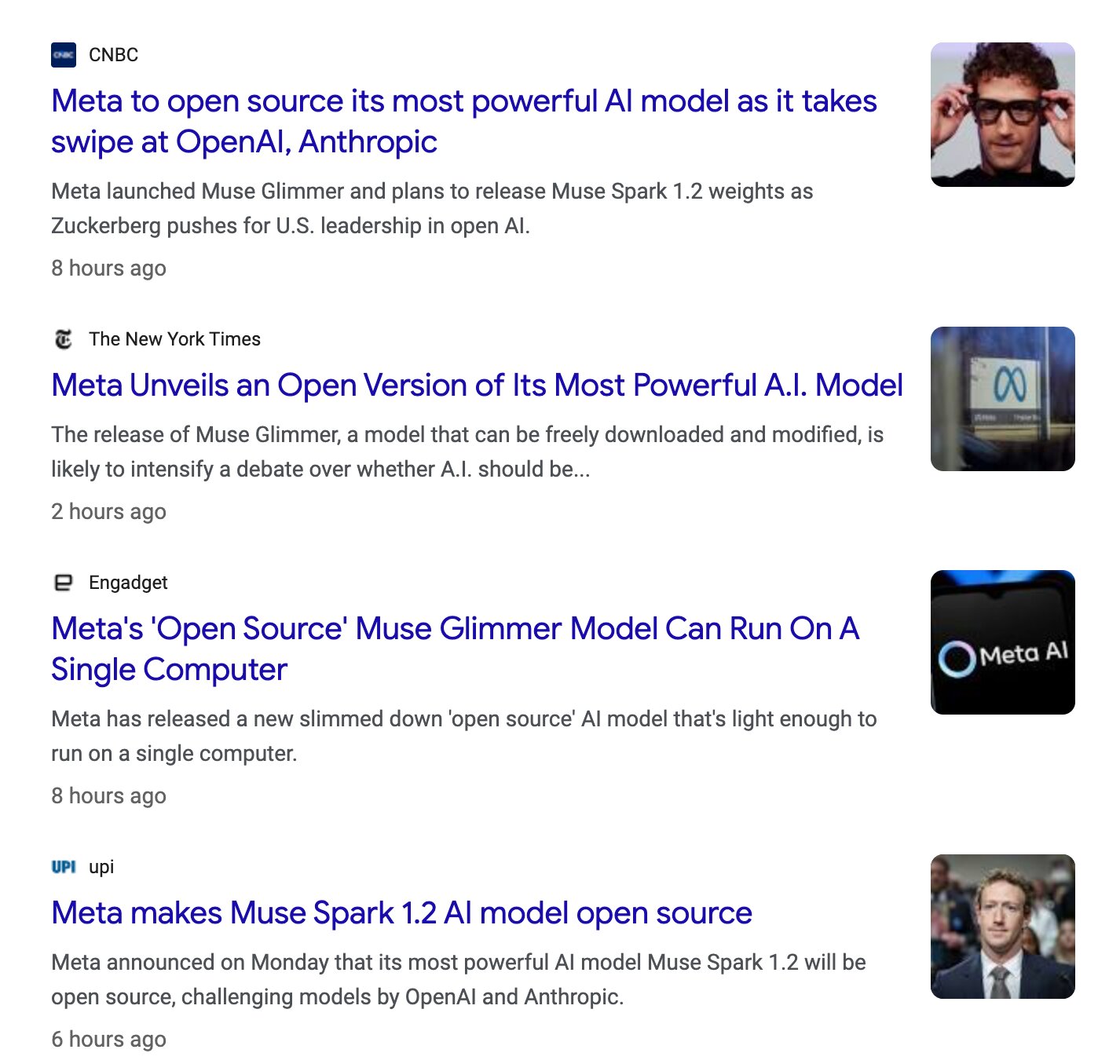
Meta announced this week that it will be open-sourcing Muse Spark 1.2, a near-frontier-level model led by Alexandr Wang.
The reversal is what makes this interesting. Meta launched the Muse line closed back in July and took real heat for it -- the eulogies for American open source were already half-written. One month later, the weights are on the way. And alongside the Spark announcement, Muse Glimmer is already out: a 30B agentic model under Apache 2.0 that quantizes to under 20 GB and runs on a single consumer GPU. Glimmer's weights are live today; Spark 1.2's are due in the coming weeks.
The model is currently on the cheaper end of the spectrum, at $1.25/million input tokens and $4.25/million output tokens, compared with Fable 5 at $10/$50, respectively.
It’s also extremely fast, averaging 121 TPS on Meta’s infrastructure.
To be clear about where it sits on capability: Artificial Analysis scores it 54 on their Intelligence Index, dead even with Grok 4.5 and seven points behind Claude Opus 5. Seven points is a real gap. Most workloads will never notice it, though, and near-frontier intelligence at roughly a tenth of the blended token price is an enormous market. AA's own framing is that Spark 1.2 is among the most cost-efficient models at its intelligence level -- about $0.40 of spend per task on their index, versus $1.18 for GPT-5.5.
Generally, I have two thoughts:
-
Models are becoming completely commoditized. Fireworks and Together will host this model for the same price or cheaper and let organizations fine-tune it to reach frontier-level intelligence for their specific use cases. Glimmer was live on Together, Fireworks, OpenRouter, Ollama, and vLLM the day it dropped, and Spark 1.2 will land the same way. When every host is serving identical weights, nobody can charge for the model anymore -- only for the serving: throughput, latency, uptime, and price per token. That competition grinds serving margins down toward raw GPU cost, and it only exists because the weights are public. This should generally scare the hell out of Anthropic and OpenAI, as there will be increasing price pressure heading into their IPOs.
-
Having this alternative in the market will decrease reliance on Chinese open-source models and lessen the pressure everyone is feeling to regulate open-source models in the U.S. Since Llama stalled, the open-weights race has basically had one side. Aaron Levie put it plainly: "America now finally has its response to the open weights AI race." Now that there's a big dog in the fight on the American tech side, it's going to be much less likely that frontier-level open source gets banned outright.
The fine-tuning piece deserves more attention than it's getting. Glimmer ships with TorchTitan recipes out of the box, and Together already runs LoRA fine-tunes on the open models it hosts. You can teach a near-frontier model your specific accounts and edge cases, then run it anywhere you want -- including on hardware you own. A closed API can't really offer that. Everyone rents the same generic model, at whatever price the vendor decides intelligence is worth this quarter.
As I’ve been saying, I’m excited to see intelligence trend toward “too cheap to meter” and increase the number of things we’re able to build with an essentially unlimited stream of intelligence.