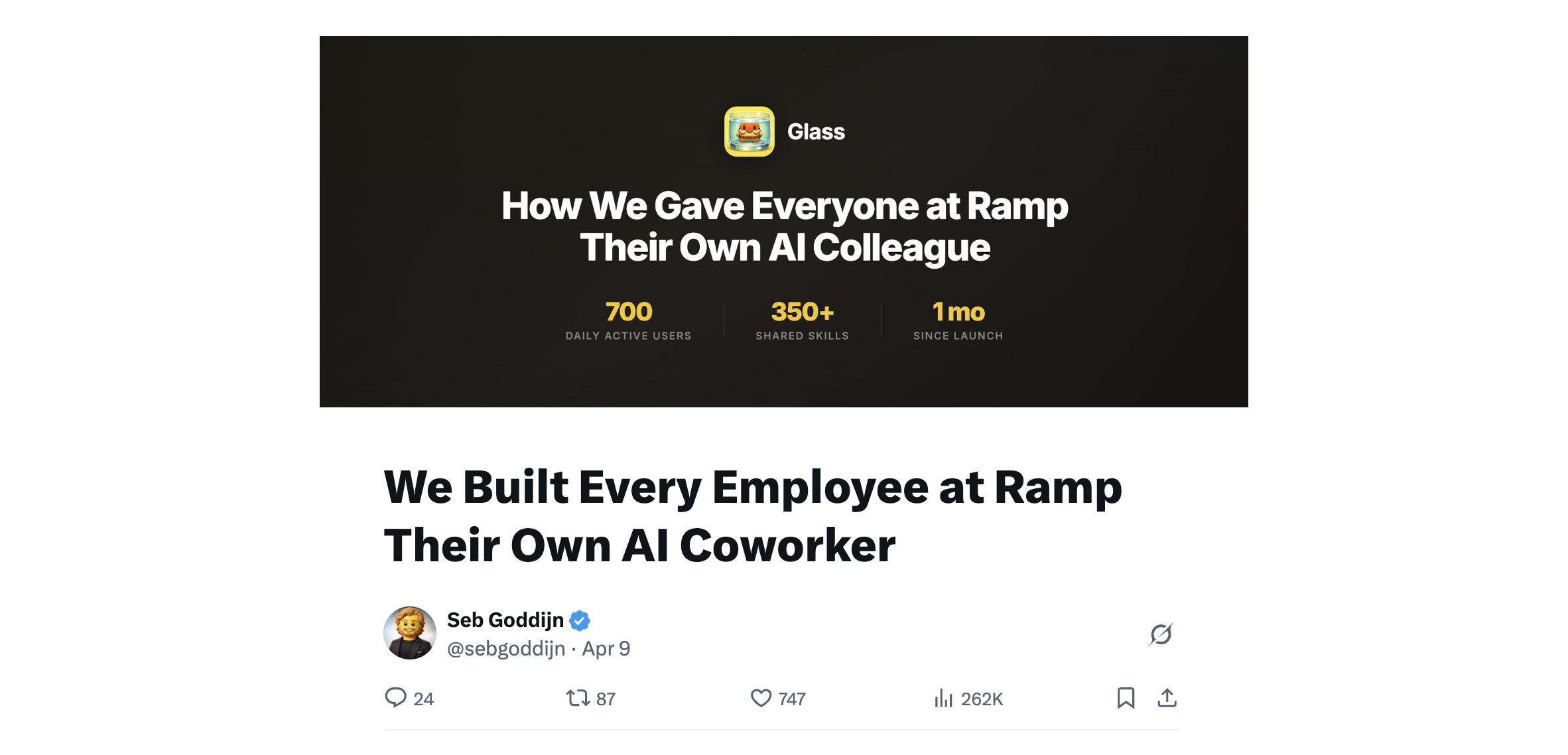
Ramp recently published a detailed look at Glass, an internal AI productivity suite they built for every employee in the company. The premise is one that anyone who's tried to roll out AI across a team will recognize immediately: adoption isn't the hard part. Making it stick is.
They hit 99% AI tool adoption. Then they noticed most people were driving with the handbrake on. Terminal configurations, MCP setups, npm installs. The friction wasn't intellectual, it was environmental. And the few people who broke through had no way to share what they'd learned with everyone else.
Why AI adoption stalls despite high usage
The AI discourse in 2026 is dominated by model capabilities. Which model reasons better, which one handles longer context, which one generates better code. But in practice, the bottleneck at most organizations isn't the model. It's everything around it.
79% of enterprises face AI adoption challenges despite massive investment. Nearly two-thirds remain stuck in the pilot stage. The pattern is consistent: companies buy licenses, employees sign up, and then nothing compounds. Each person uses AI in isolation. There's no shared infrastructure, no reusable workflows, no way for one person's breakthrough to become everyone else's baseline.
Ramp identified three things that actually move the needle: tools connected on day one so the AI has context, reusable skills that can be shared across the organization, and the product itself serving as the enablement layer rather than training programs or workshops.
What Ramp's Glass actually solves
Glass is a full workspace (not a chat window) with split panes, persistent memory, scheduled automations, and a skill marketplace called Dojo where employees package workflows as shareable markdown files. Over 350 skills have been shared company-wide. An AI guide called the Sensei recommends the right skills based on your role and connected tools.
The architectural details matter. Memory is built automatically from your connected integrations. Automations run on cron schedules and post results to Slack. Everything connects via Okta SSO on day one. No configuration required from the employee.
Why most companies can't build their own Glass
Glass is impressive. It's also the kind of project that required a dedicated team of six, months of development, and deep integration with internal systems like Okta SSO and proprietary APIs. Ramp is a $32B company with the engineering talent and budget to justify a custom build.
Most companies don't have Okta SSO, a dedicated IT team, or the ability to deploy custom internal software. A founder running a 10-person team, a RevOps manager at a Series A startup, a solo operator trying to automate their morning reporting. They all have the same problem Ramp's employees had. The model is good enough. The harness isn't set up. And they have no way to build the same solution.
How to close the AI infrastructure gap without engineering
The infrastructure that makes Glass valuable isn't conceptually complex. It's three things: connected integrations so the AI has real data to work with, reusable workflow templates that encode what "good" looks like, and scheduled automations that run without human involvement.
General Input provides that scaffolding as a turnkey product. Connected tools on day one. Secure by default. Deployable on your infrastructure so data never leaves your walls. You connect your tools once, Google Workspace, Stripe, Slack, Notion, Salesforce, and 850+ others. You describe a workflow in plain English and the AI builds it. Templates are installable in one click. Automations run on cron and deliver results to Slack, email, or wherever you need them. No IT team required.
A solo founder can set up a morning briefing that pulls yesterday's Stripe revenue, today's calendar, and flagged emails into one AI-compiled summary. A customer success manager can build a failed payment recovery pipeline that drafts personalized emails every morning. An ops lead can share a workflow template with their entire team the same way Ramp shares skills through Dojo.
The floor rises for everyone
The most compelling line in Ramp's article is the last one: "We don't believe in lowering the ceiling. We believe in raising the floor."
That's the right frame. The goal isn't to simplify AI until it's useless. It's to make the full capability accessible without requiring every person to become a power user on their own. When the infrastructure does the heavy lifting, connecting tools, sharing workflows, maintaining context, people learn by doing. The product is the enablement.
Ramp proved the thesis internally. The challenge now is making that same infrastructure available to the other 99% of companies that can't build it themselves.