
Background
A mid-sized manufacturer shipping to customers around the world
Newtex Industries manufactures high-temperature textiles and protective products in Victor, New York, and ships them to customers around the world. Like a lot of mid-sized manufacturers, it runs on an ERP that does the core job well and makes everything around it hard: forms, reports and the paperwork that moves between them.
In January, CEO Jerry Joliet made AI proficiency a major objective for Newtex’s senior staff. The team now runs AI specialists in General Input across sales, operations and finance. Export documents that used to be retyped by hand come together in seconds, and financial reports that once needed custom code are a conversation away.
The problem
Fifteen-year-old spreadsheets and reports that took code to change
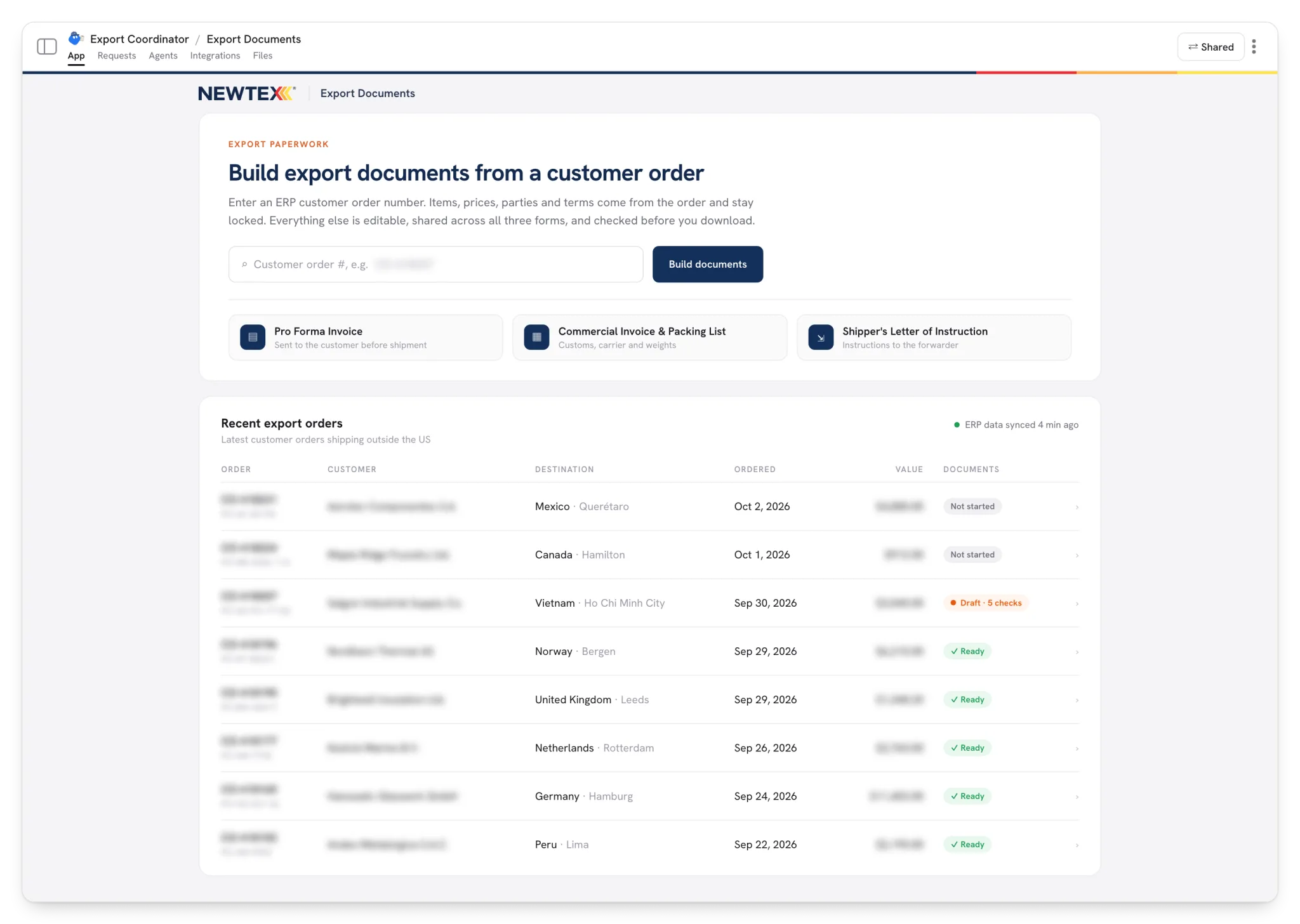
Every international order Newtex ships needs three documents before it leaves the building: a pro forma invoice so the customer can arrange shipping and customs, a commercial invoice and packing list for customs and the carrier, and a shipper’s letter of instruction for the freight forwarder. 90% of the information is the same across all three.
The ERP could print an order confirmation, but changing its forms meant working in old code. “Coding a form in any ERP is a nightmare,” says Jerry. “It’s old code. It’s not drag and drop.” So fifteen years ago Newtex built its own forms in Excel. They looked professional, but nothing in them was automated, and every export order was retyped by hand.
Each document took 10 to 12 minutes. At four export orders a day and three documents per order, that added up to two hours of skilled time, every day.
Reporting had the same problem. Leadership reviews the financials a couple of times a month to track performance, and the reports lived in a business intelligence tool that was powerful but hard to set up. “It was hard,” says Jerry. “I had to actually code them in some cases.”
Outside help hadn’t fixed it either. Over the last decade, Newtex hired three consultants who were supposed to be experts to optimize its ERP planning process. None of them delivered any value, and Newtex’s own people often ended up teaching the consultants how the business worked.
Meanwhile the team was stretched. Newtex’s people are process-driven and focused on productivity, and they embrace anything that makes the work faster and more efficient. What they lacked was a tool that could keep up.
The solution
AI specialists that build export documents in seconds and financial reports on request
Export documents, built in under an hour
Exports came first. Jerry wanted to see how fast the work could be automated, so he built the beta himself. He created an Export Coordinator specialist and gave it one sentence of instructions: manage export paperwork, look up and store HTS codes, find tariffs, and create the pro forma invoice, commercial invoice and shipper’s letter of instruction. He pointed it at the existing forms in Google Drive and a recent export order, and asked it to build the documents from that order. “I literally did this in less than an hour,” he says. Then he handed it to Lindsey, Newtex’s VP of Sales, who tested and tweaked it and is rolling it out to her team.
Now someone on the team enters a customer order number and the app builds all three documents. Items, prices, parties and terms come straight from the ERP and stay locked. Shared details like incoterms, weights and HTS codes are entered once and flow into every document, and a checks panel lists exactly what a person still has to add or confirm before anything is downloaded.
The documents look like Newtex, too. “I don’t even think we gave it design instructions,” says Jerry. “We just said, these are our colors, this is our logo, make it look good.”
Financial statements, built by conversation
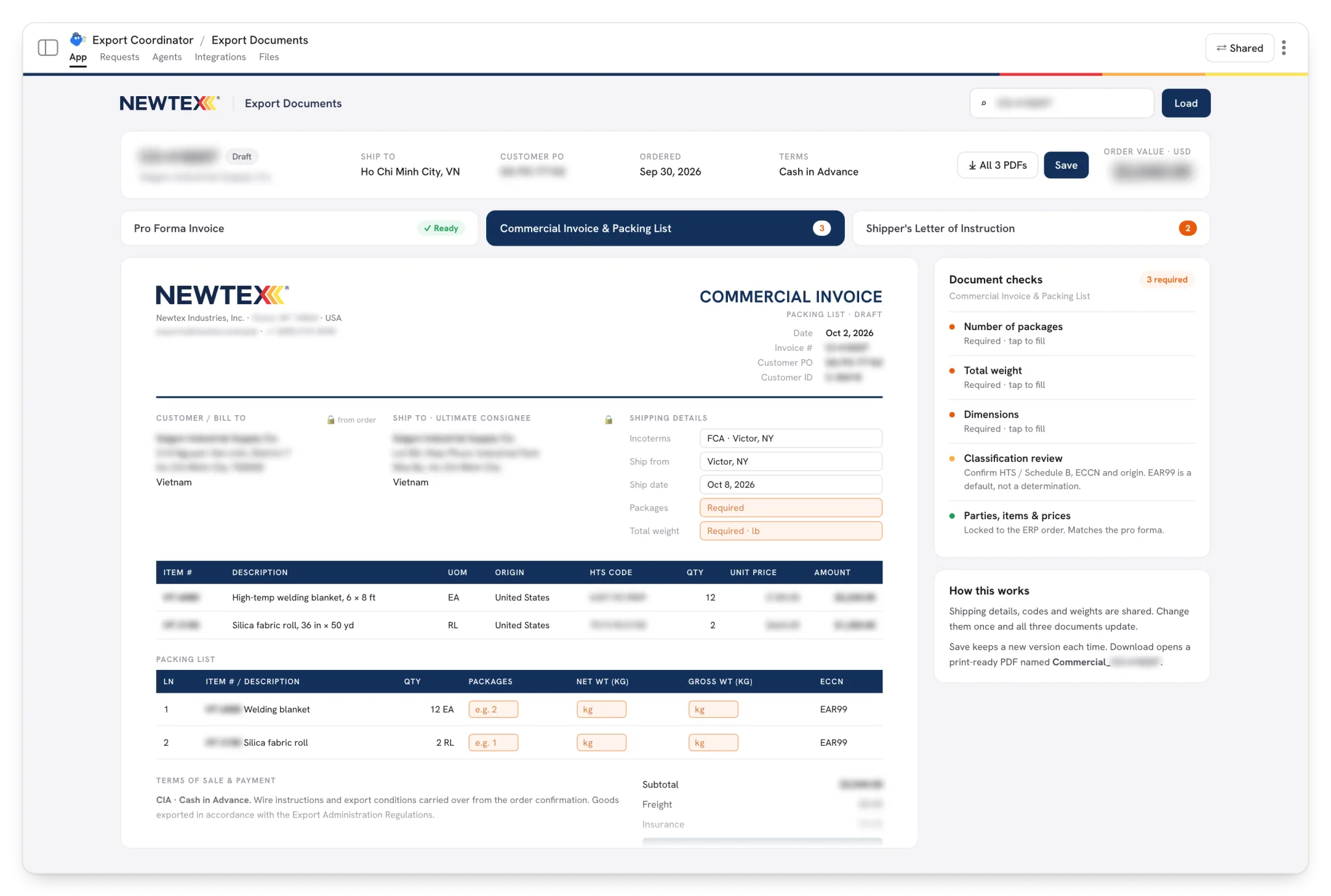
Finance came next. The financial statements app in the Accounting Manager specialist was built “by giving it some structured data and talking to it,” says Jerry. It read the spreadsheets Newtex had already built and mapped the general ledger to the statement lines finance uses.
The income statement compares the current period to last year with percent-of-sales and change columns. Cost of goods sold breaks down into material, labor, overhead and variance, EBITDA is built up with Newtex’s standard adjustments, and the app writes notes on the largest items. When finance wants something new, it asks in the same conversation.
A specialist for every department
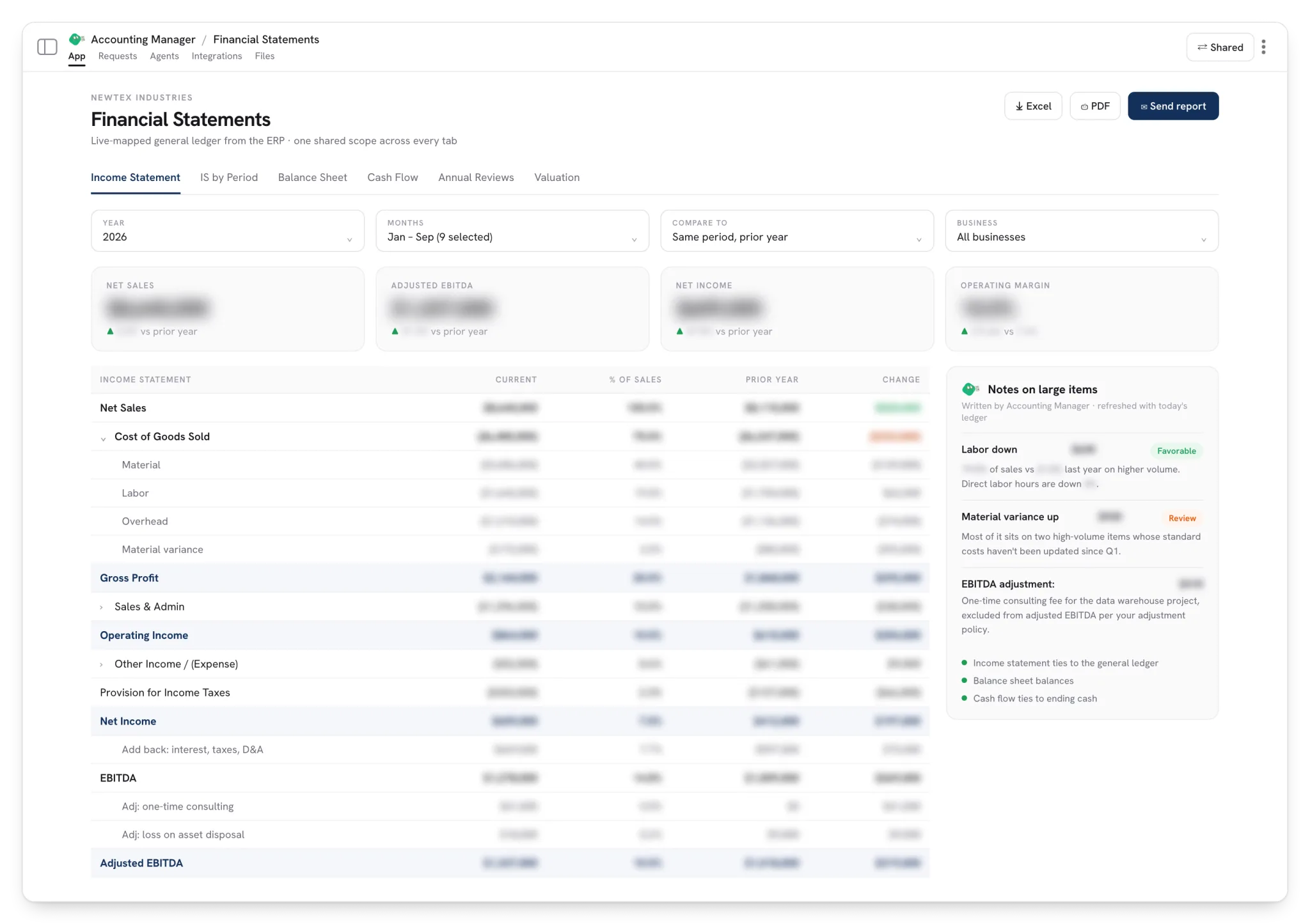
Exports and finance were only the start. Newtex now has a specialist for every department, each set up like a new hire for one part of the business, with its own files, apps, connections and conversation history. Each app is shared with the people who use it every day.

Document Librarian
Invoice checking
Matches every supplier invoice against the purchase order and the receiving record, line by line, and flags only what doesn’t match.
Before: checking every invoice by hand

Accounting Manager
AP Aging Tracker
Shows every open bill by age. Finance deselects small, barely late ones and sees the outbound total update before payments go out.
Before: a weekly report export to Excel

HR Manager
Payroll hours and earnings
Live data from the payroll system, by person and by year, with hours-based productivity measures for manufacturing next.
Before: a monthly payroll download merged into reports

Planning Manager
Bills of materials
Traces every component and cost under a product, working toward a list of what to order and what to produce for the next 90 days.
Before: three consultants in ten years

Pipeline Manager
Lead research
Researches each new lead in the CRM and sends the team a digest twice a day.
Before: an email for every new lead

Travel Planner
Personal
Scans Gmail for airline and hotel confirmations and keeps a dashboard of upcoming trips and what each one cost.
Before: digging through the inbox
The results
Hours back every day, redeployed to revenue
Export documents that took 10 to 12 minutes each now come together in seconds, and a person reviews only what the checks flag. “Is it ready to go? No,” says Jerry, “but it’s 99% of the way there.” On the finance side, leadership gets an income statement, EBITDA bridge and notes whenever they need them. “Right now the app is actually much easier to use than [our BI tool],” he says, and Newtex is now building toward replacing that tool entirely.
The same idea runs through every specialist: the software does the checking, and people look only at what’s wrong. “Instead of doing all the work that we used to do, we’re only going to look at exceptions,” says Jerry.
The whole team uses General Input. Lindsey, the VP of Sales, is using it to review what each customer does and buys, find companies in the same applications that Newtex doesn’t sell to yet, and build campaigns that bring in inbound leads. “She’s learned AI, and her skills are expanding daily,” says Jerry. “I have employees that are having fun with it, because it’s just mind-boggling how quickly you can do it.”
Next, Newtex is moving its ERP and payroll data into a central data warehouse and building out invoice matching and production planning. “I expect every business process that runs on spreadsheets, Drive or Google Forms to be rebuilt in General Input,” says Jerry.
“We hired three consultants who were supposed to be “experts” in the last decade to optimize our [ERP] planning process, and none of them delivered any value. Now the people who actually know the work can build it themselves.”


 General Input