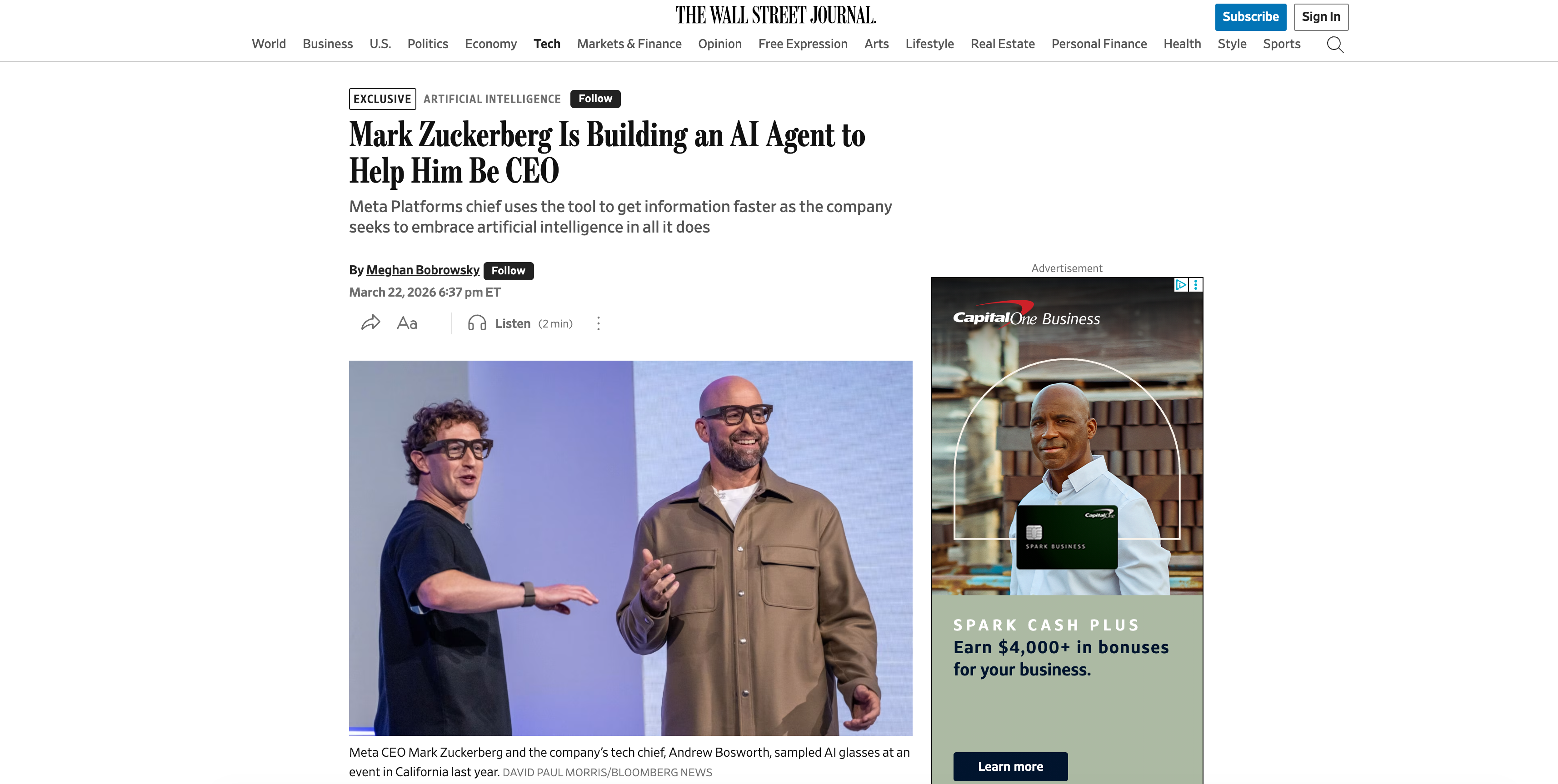
Mark Zuckerberg just built himself an AI agent. Not for Meta's 3 billion users. For himself. According to the Wall Street Journal, the agent helps him "retrieve answers he would typically have to go through layers of people to get."
That sentence should resonate with anyone who runs a team.
What the Monday morning data pull actually looks like
Most managers don't have layers of people between them and the data. They are the layer. They're the person everyone pings when they need a number, and they're the person who has to go get it from four different systems.
A typical Monday morning looks something like this: log into Salesforce, pull the pipeline by stage, export to a spreadsheet. Open Stripe, check collected revenue and failed payments. Open Google Sheets, paste everything into the weekly report template you built six months ago. The one held together by formulas you're afraid to touch.
One ops manager described inheriting a weekly revenue report with eight source inputs that took four hours to run on a good day. Leadership spent about five minutes reading the actual insights.
Why Zuckerberg's AI agent matters beyond Meta
The interesting thing about Zuckerberg's CEO agent isn't the technology. It's the framing. He didn't hire another chief of staff. He didn't build a dashboard. He built something that goes and gets the answer for him, from whatever system it lives in, and brings it back.
Meta's employees are doing the same thing internally. A tool called Second Brain, built by a Meta employee on top of Claude, is described as an "AI chief of staff" that indexes documents and answers questions across projects. Employees have personal agents that talk to their colleagues' agents on their behalf.
This is happening at a company with 78,000 employees and a $1.5 trillion market cap. 62% of organizations are now experimenting with AI agents, and the market is projected to hit $10.9 billion this year. The question isn't whether AI agents are ready for business operations. It's whether you're going to keep being the human version of one.
How to build a revenue agent in 3 minutes
You don't need Meta's engineering team to build something useful. Here's a concrete example.
I gave a specialist the prompt: "Every weekday at 7am, answer these questions and email me the answers: How much did we collect yesterday? (Stripe) Are any payments failing right now and who owns those accounts? (Stripe + Salesforce) What deals are closing this week and are any overdue? (Salesforce) Who am I meeting with today and what's their deal status? (Google Calendar + Salesforce) Did anyone cancel or downgrade yesterday? (Stripe) Keep it short. Bold the numbers. Flag anything urgent at the top."
That took about 3 minutes to set up. It costs a few cents per run. Now every morning, the answers land in my inbox before I open anything else.
Five revenue workflows worth automating
Once you see how this works for the Monday brief, the natural question is: what else am I compiling by hand?
Deal risk detector
Every day, scan Salesforce for deals past their expected close date or with no activity logged in the last 14 days. Cross-reference Stripe for any failed payments on those accounts. Send a risk digest to the sales manager in Slack with deal names, owners, and the specific risk signal.
Forecast vs. actuals reconciliation
At the end of each month, pull the forecasted revenue from Salesforce and compare it to what Stripe actually collected. Calculate variance by rep and by segment. Deliver the reconciliation as a Google Sheet and post a summary to Slack.
CRM data hygiene scorecard
Every Friday, audit Salesforce deals for missing close dates, blank amount fields, and empty next-step notes. Calculate a data completeness percentage per rep. Send each rep their score via Slack with the specific fields to fix.
Account 360 briefing
Before any customer meeting, pull the Salesforce deal record, Stripe payment history, and recent Zendesk tickets. Compile a one-page briefing in Google Docs and share the link in Slack.
New deal auto-enrichment
When a new opportunity is created in Salesforce, enrich the company using Company Enrichment and search for recent news with Internet Search. Add firmographic data and a news summary to the deal description so the rep has context before their first call.
Stop being the human middleware
Zuckerberg's insight wasn't complicated. He wanted information faster and he realized the bottleneck wasn't the data. It was the path between him and the data. He built something to shorten that path.
If you run a team, you probably recognize that bottleneck. You are the path. Every Monday morning, every end-of-month close, every "hey can you pull the numbers on..." ping in Slack. The information exists. It just lives in five different tools and someone has to go get it.
That someone doesn't have to be you anymore.